You Only Get to See It From the Outside Once
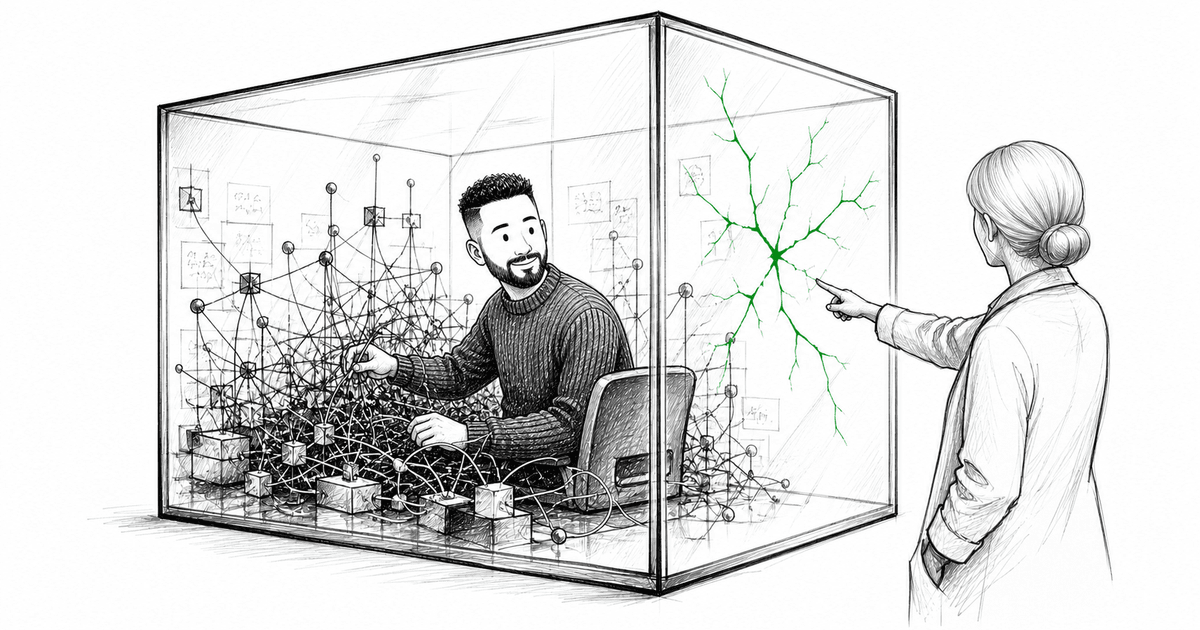
I was in the middle of writing this article when my wife started giving me notes on it. And I did the thing I apparently do — I pushed back. I explained that engineering is different on the inside, that the processes don't work the way she was picturing, that she was missing context. I had reasons. I always have reasons.
She let me finish. Then she pointed out, pretty gently, that I had just acted out the entire premise of the article I was writing. She was the outsider looking at my argument with fresh eyes. I was the one who had already climbed inside it and could no longer see it straight. On an article that is specifically about that. She was out of the box. I was in it. And I couldn't tell until she said so.
That small, slightly embarrassing moment is the whole thing I want to talk about.
The asset nobody writes on the offer letter
When an experienced person — an architect, a staff engineer, a senior hire — joins a project, they show up with something that has nothing to do with their résumé. For a short window, they can see the project from the outside. They notice the thing that makes no sense. They ask "why is it like this?" about the part everyone else stopped seeing a year ago. They feel the friction a new user feels, because right now they basically are a new user.
That vantage point is not a bonus on top of the "real" work. For a lot of senior hires, it is the work — or it should be. You're not paying a premium for another pair of hands to type features. You're paying for someone who can still look at the whole thing and tell you, honestly, what's wrong with it before they've been anesthetized into thinking it's normal.
The outside view is the most valuable thing an experienced engineer brings — and it's the first thing a team destroys without meaning to.
It has a shelf life
Here's the cruel part. That view is perishable. It doesn't last. Six months in, you've internalized the map. You know where everything lives, which means you've stopped noticing that nothing should live there. You know why the weird thing is weird — there's a Slack thread, a migration, a reason — and knowing the reason is exactly what makes you stop seeing that it's a problem. You've learned where the bodies are buried, so you no longer notice you're standing in a graveyard.
Keeping the outside view alive past that honeymoon is genuinely hard. It takes deliberate effort from the person, and — much more — a culture that protects it. Most places have neither. So the clarity that walked in the door on day one quietly evaporates, and in a year that same brilliant hire is defending the exact weirdness they were hired to question.
How teams burn it on day one
The way companies destroy this asset is almost always the same, and it's well-intentioned. They hire a senior person because there's a hot new feature, or a new branch of the product, or a fire. And then, on day one, they submerge them: "Great, let us walk you through how everything works here." Onboarding as immersion. The clock starts, the deadlines are already there, and the expectation is feature output by roughly week two.
Think about what that does. You took the one person who could still see the project from the outside, and you rushed them inside as fast as possible. You spent their most valuable, most perishable asset on getting them productive on tickets — and you never once asked them the question only they could answer for a few short weeks: what looks wrong to you right now, before you get used to it?
What they actually needed was a little room. Time to pick the thing up, turn it over, feel how it behaves, and notice. Time to reflect. That's not slacking; that's the senior work. But reflection has no line in the sprint, so it's the first thing the deadline eats.
I hit this wall myself
Let me be specific, because I lived the other side of this. A few years back I joined a Canadian health-tech company in a good, senior role. I was there about six months, and then we parted ways — not dramatically, but because what they wanted and what I was doing had quietly stopped being the same thing.
I did a lot in those months. I set up practices, fixed how a bunch of things were used. Their setup was wild in places — a designer could change a button through an AI tool more or less directly. There was review, technically. But there was essentially zero consistency in the code. And every time I actually picked the project up to work in it, it came apart in my hands. Long legacy, dressed in modern libraries, with no architecture underneath — you genuinely could not tell where anything lived or why.
Here's the mismatch. What I was offering them was the outside view: I'm looking at this thing fresh, and I'm telling you it doesn't hold together. That was the most useful thing I had. But what they wanted, increasingly, was for me to stop looking and start shipping — hands inside the box, features out the door. They'd hired a senior and then asked him to stop doing the senior part. I couldn't unsee what I was seeing, and they didn't want to act on it. So it ended.
I'm not telling that story to settle a score. Honestly, I get it — the pressure to ship is real and it's not villainy. I'm telling it because it's the clearest example I have of a company holding a valuable asset and spending it on the wrong thing. They paid for an outside view and then treated it as an obstacle to velocity.
For the manager, and for the senior
So this cuts two ways, and I want to be clear about both, because the two audiences own different halves of the fix.
If you manage senior hires: the outside view is an asset with an expiry date, and you are almost certainly burning it. The window where a new architect or staff engineer can tell you what's actually wrong is measured in weeks, not quarters. Protect it. Before you submerge them in "how we do things here," ask them what looks broken while they can still see it — and write it down, because in three months they won't be able to tell you anymore. And then think about the harder, cultural problem: how do you keep anyone on the team seeing the product from the outside once the honeymoon ends? That's the real work of engineering culture, and it doesn't happen by accident.
If you are the senior: your value was never the volume of code you produce. Plenty of people can produce code. Your rare, decaying advantage is that right now you can still see the box from the outside. Guard it. In your first weeks somewhere new, write down everything that looks wrong, everything that makes you go "wait, why?" — because that document is worth more than the features you'll ship in that same period, and you will not be able to write it later. You'll have gone native.
The reframe
The thing that still gets me about the moment with my wife is how fast it happened, and how invisible it was to me. I wasn't being stubborn on some project I'd spent years on. I'd been inside my own article for a couple of days, and that was already enough to make me defend it against exactly the kind of outside perspective the article is arguing you should protect. If it happens that quickly to me, on a piece of writing, imagine what six months of deadlines does to a person's ability to see the system they work in.
The outside view isn't a personality trait. It's a position — you're either standing outside the thing or you're inside it — and you lose it the moment you step in and get comfortable. Which means the whole game, for teams and for individuals, is noticing that the window is open right now, and using it before it quietly closes.
Think about the last time someone from outside your project — a new hire, a designer, someone who doesn't live in the code — told you something was wrong, and your first instinct was to explain why they didn't understand. That instinct is the tell. I'd genuinely like to know what they were seeing that you couldn't — reach out and tell me, because odds are they were standing exactly where you used to.
More than a blog post
I share frontend news and the reasoning behind it throughout the day. Pick the language that feels natural to you.