Review Agent: A Personal Review Workspace, Not Another Bot
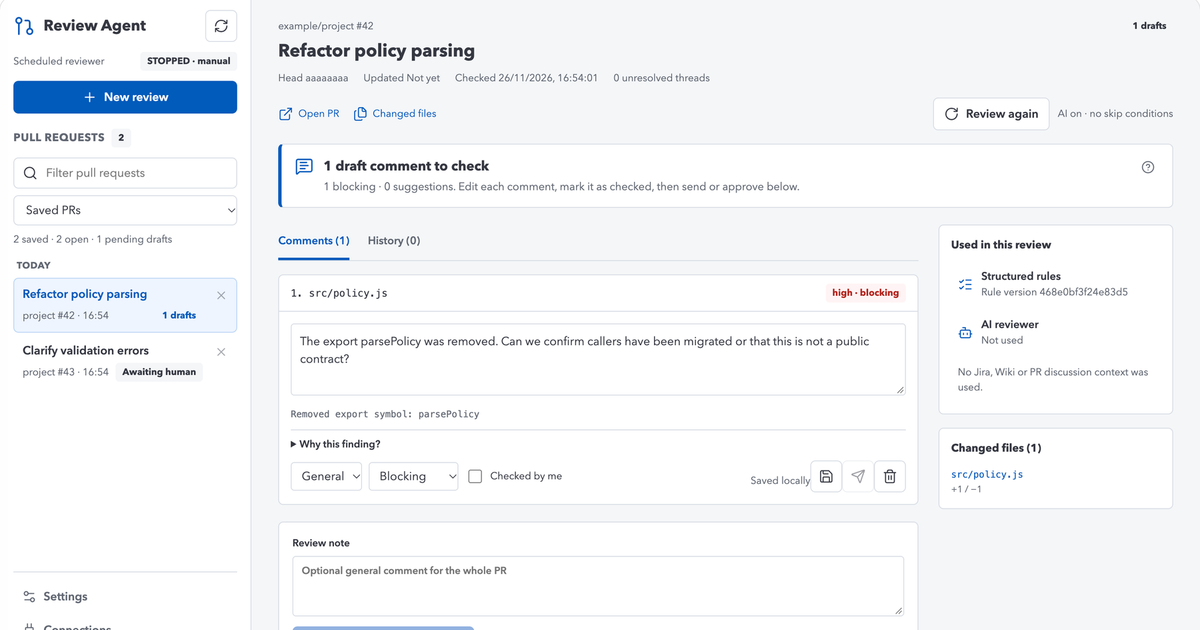
Follow enough repositories and review becomes partly a navigation problem.
One pull request needs another look. Another has new commits. A third has a discussion you don't want to repeat. You remember writing a useful comment somewhere, but not whether you actually sent it.
The obvious response is another bot. I wanted something a little more personal: a reviewer I could configure around how I work, with a place to inspect its suggestions before they become my comments.
I built Review Agent as a hackathon-style experiment. It is still an experiment, not a finished hosted product or a claim that automated review can replace an engineer. The repository is open under the MIT License, and people are welcome to try it, adapt it and tell me where it gets in the way.
In the earlier article, I wrote about the initial shape: watch my requested reviews, look for known risks and make the comments sound like a careful engineer rather than an alarm system.
The project has grown considerably since then. The important change isn't simply that it checks more things. It now has a local workspace where I can run a private review, edit the result, inspect its sources, tune the rules and decide what, if anything, goes to GitHub.
AI drafts. Engineers decide. The interface needs to make that distinction real.
The screenshots show the actual workspace with synthetic example PRs and instructions, captured in Microsoft Edge. They contain no real review history or work data. The example finding comes from an offline structured rule, not a model-quality demonstration.
Start with one PR, not with automation
You don't have to turn on an hourly service to use it.
Open New review, paste a GitHub pull request URL or a reference such as example/project#42, choose whether to include AI and select Review privately. That starts an individual background job. It doesn't enable the scheduled reviewer, and it never publishes the result.
There are optional launch conditions for failing CI, unresolved review threads and draft PRs. In a private run they start unchecked, so you can inspect a change before it is ready to merge. Selecting a condition makes that check mandatory for that run.
That distinction is useful. Looking at a draft is not the same as approving it. Allowing early analysis should not silently weaken the checks applied before anything is sent.
Saved PRs live in a searchable sidebar grouped by date. Reopening one shows its review result, comments, requirements, context, AI analysis and history where those sections have data. A side panel lists what was used in that review, including the rules revision and available task sources.
The Review result matters even when there are no comments. An empty comment list used to leave too much interpretation to the reader. Now the workspace states what happened, without turning a quiet result into a promise that the change is correct.
Your comments are drafts, not an output stream
A proposed comment can be edited, classified as blocking or a suggestion, kept inline or made general where the location allows it, and marked Checked by me.
Save draft locally does exactly that. Send comment to GitHub is another action. Sending the remaining checked comments is separate from approving the PR, and approval can optionally include comments.
That is a fairly ordinary interface decision. It is also a substantial part of the safety model. I don't want saving a better sentence to have the side effect of publishing it.
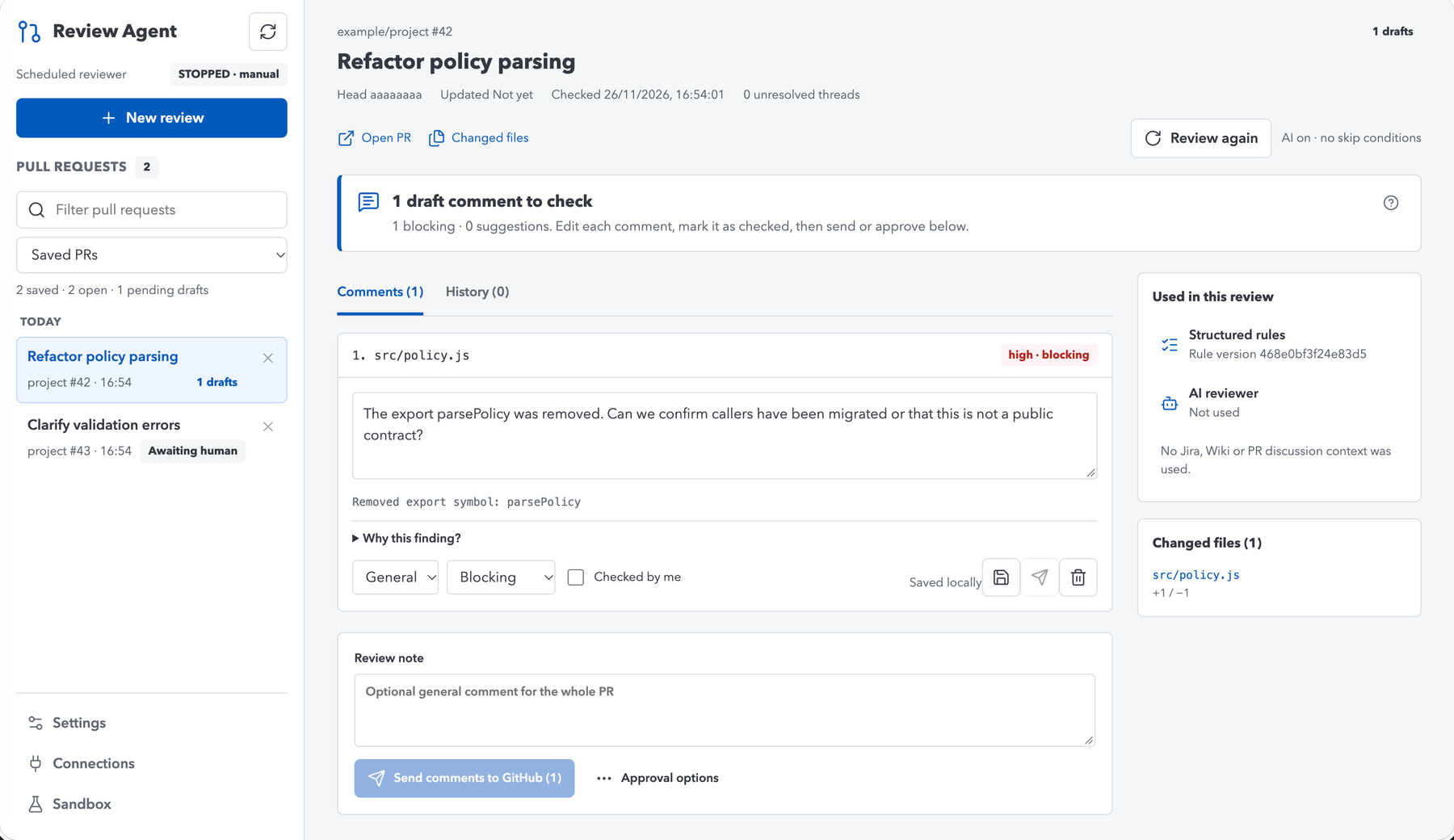
Demonstration PR: a removed-export concern stays a local, unchecked draft. The source panel shows that AI was not used.
Before a send, the application checks the current PR state, head commit, rules revision, CI and relevant discussion. Inline locations must still be valid. Approval also needs resolved threads and the other required evidence. A stale browser tab doesn't get to publish yesterday's finding onto today's code.
The agent preserves human edits when it reconciles findings. A moved or changed concern may need checking again. If an AI pass is incomplete, it cannot quietly resolve an earlier AI concern just because the new response omitted it.
There is an unglamorous case I care about: a send request times out and nobody knows whether GitHub accepted it. The application records an unknown outcome and blocks another send. Verify delivery checks for the request marker without posting again. Retrying until the network looks happier is a good way to leave the same comment twice.
Rules for repeatable checks, instructions for judgment
Review Agent has two different customization layers.
Structured rules match declared patterns in changed code. They work without a model. The defaults include dynamic code execution, suspicious HTML assignments, removed exports or contract fields, disappearing access checks and install-time scripts.
For example, the removed-export rule can turn this synthetic change into a compatibility question:
-export function parsePolicy(input) {
+function parsePolicy(input) {
   return parse(input);
 }
The useful observation is that an export disappeared. It is not proof that a downstream consumer breaks. The comment should ask whether callers were migrated or the function was never part of a public contract.
In Settings, rules can be enabled, edited, added or removed. Fields have explanations and examples. The examples can create a disabled, unsaved starting point rather than quietly activating a new check.
The second layer is Personal review instructions: free text, in any language, for the optional AI reviewer. An illustrative set might be:
Focus on changed behavior and error handling.
Check whether validation still happens before persistence.
Avoid style comments unless they hide a correctness issue.
Explain the evidence and conditions behind each concern.
If the needed context is missing, say what you couldn't verify.
Those preferences add to the structured rules; they don't replace them. They also aren't executable static-analysis rules. If I ask for an exact complexity threshold, the model shouldn't invent a measurement. That needs a suitable analyzer, which remains planned work.
Saving instructions stores them locally and changes the review revision. It doesn't run AI. When an approved model run happens, the selected code, instructions and applicable context go to the configured provider. A local interface does not mean local inference.
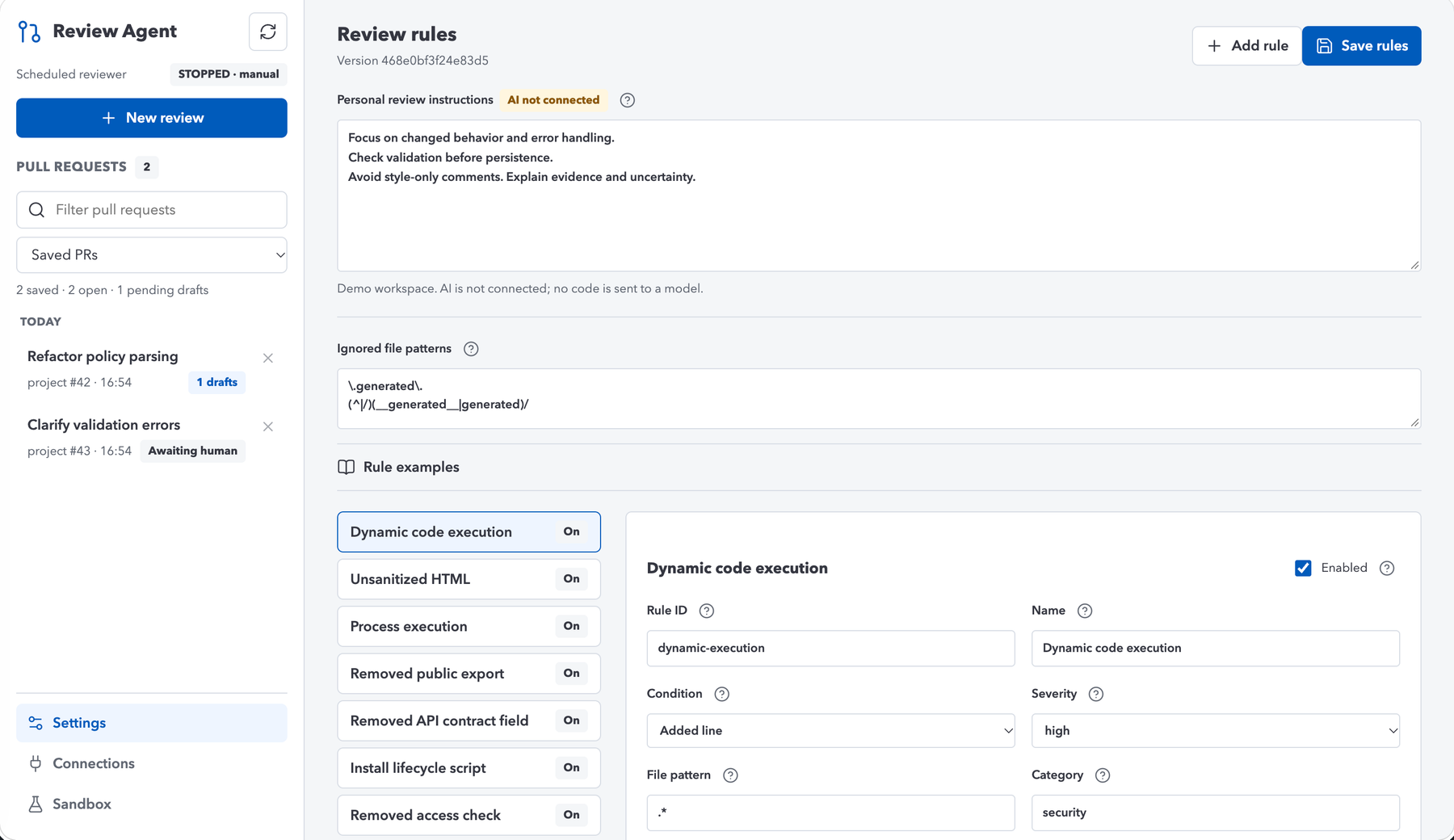
Example preferences, not my private configuration. The disconnected AI status is intentional: storing instructions doesn't run them.
Try a rule before giving it a review queue
The Sandbox accepts code or a unified diff and a repository-relative path. It applies the saved rules without executing the sample or changing a PR.
That is a much better place to tune a pattern than a colleague's pull request. Change the sample, inspect which rule matched and open Why this finding? to see the evidence and limitation.
AI is off by default in the sandbox. Enabling it requires confirmation, just as a private AI-assisted review does. A sandbox result is never published.
Pattern matching still has ordinary pattern-matching limitations. A sanitizer can live outside the supplied fragment. An access check can move rather than disappear. The point is to make the signal explainable and adjustable, not to rename a regular expression semantic understanding.
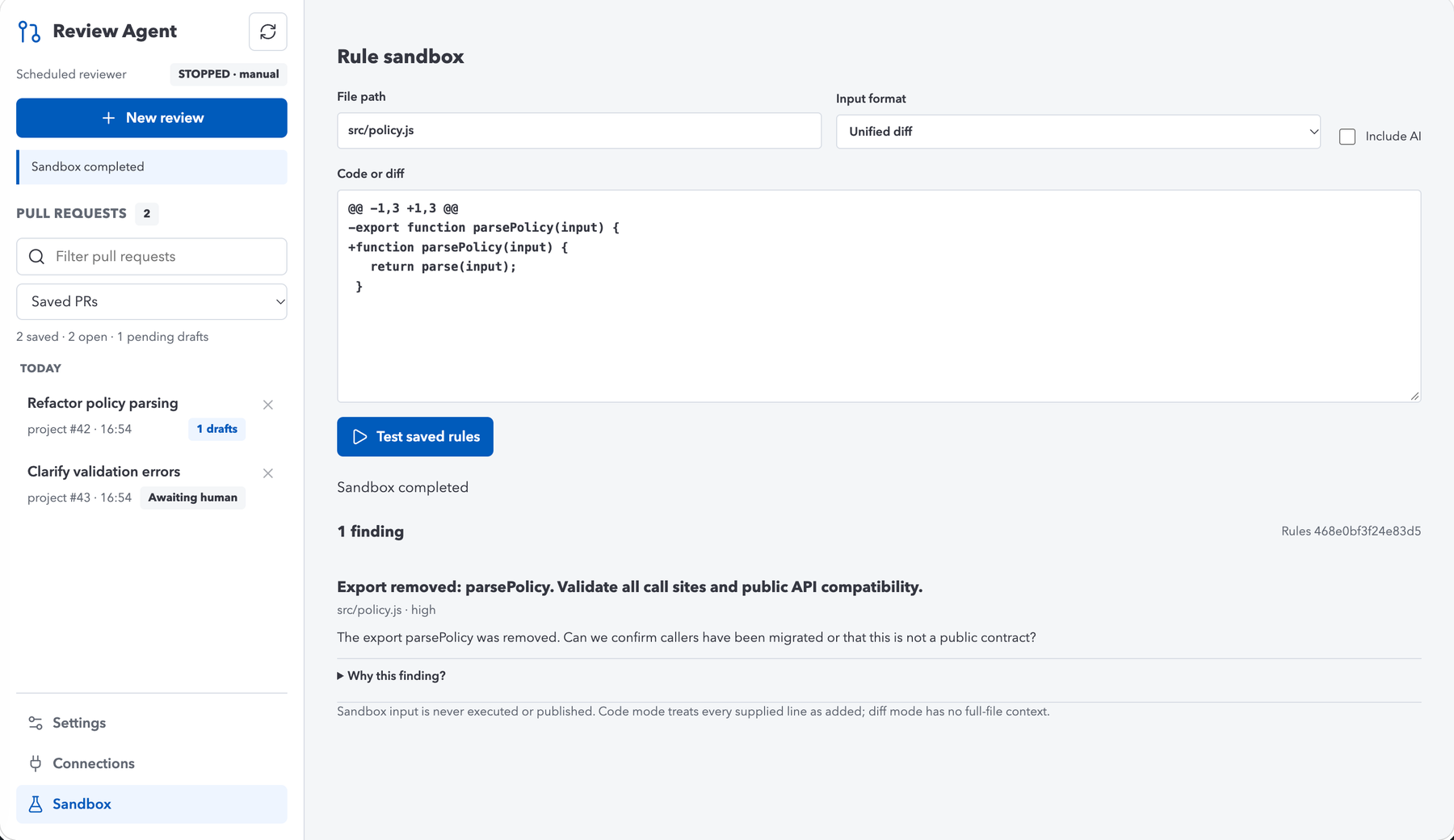
The same synthetic export change, tested without executing its code, contacting a model or publishing a comment.
Context includes the task and the conversation
A code-only review can miss why a change exists. It can also repeat the concern already discussed three comments above.
The application can collect Jira descriptions, acceptance criteria, parent and related issues, recent comments and referenced Confluence material through a read-only Model Context Protocol (MCP) client. MCP is the integration protocol here, not a separate source of authority.
An optional ticket can be supplied manually; relevant references can also be discovered from the PR and discussion. Source identity, retrieval time and bounded excerpts remain visible. Missing acceptance criteria do not become invented criteria, and manually edited criteria are labelled as manual rather than verified Jira data.
With AI enabled, criterion assessments distinguish supported, not-demonstrated and needs-clarification. These are source-backed proposals from static review, not executed acceptance tests. A plausible explanation doesn't establish that the business requirement is complete.
Wiki search matches are supplementary context, not extra requirements someone silently added to the ticket.
For existing PR discussion, matching uses markers, text and locations. A possibly repeated draft asks for explicit human acknowledgement before a manual send; automatic publication excludes it. This is deliberately conservative, not a claim that the agent understands an entire conversation semantically.
Big PRs need visible coverage, not optimistic silence
The manual and scheduled modes share the same context preparation. Large changes are divided into bounded requests rather than handled by pretending the first fragment was the whole PR.
The workspace shows batch and per-file coverage, including source fragments, unavailable material and unprocessed work. Missing or invalid AI results remain incomplete and cannot authorize approval or automatic publication.
Large npm JSON lockfiles get a structural base/head comparison. The reviewer receives dependency changes rather than an enormous generated text dump. That is a declared dependency comparison, not a claim to have read every line. Findings based on it are general comments, not invented inline locations.
There is another distinction I wanted visible: "tests were not executed" is an informational caveat for static review. "I couldn't inspect the required file" is an unmet check. Neither should be hidden, but they shouldn't be collapsed into the same coverage label either.
Scheduling is optional, and its controls matter
The hourly requested-review workflow still exists. Its service integration is currently macOS-only; the browser workspace also supports Windows, while Linux is not regularly tested.
Starting the local panel does not start the reviewer. Settings > Scheduled reviewer contains separate manual and automatic starts, with confirmation and the conditions shown before launch.
Manual mode prepares local drafts. Automatic publication needs both automatic mode and an explicitly enabled publication setting. It can publish comments or change requests, and it has a separate option for approving clean results automatically.
You can turn that approval option off while retaining automatic comments. An eligible clean result can instead show Approval suggested, leaving the decision to you. That mark is not a human approval and not proof the PR is safe to merge.
I wouldn't begin by enabling every automatic behavior. Private reviews and the sandbox make it possible to learn how the configured reviewer behaves before giving it permission to speak unattended.
What it takes to try it
The repository contains setup, integration, adapter and architecture documentation. The basic workspace needs Node.js 22 or newer and an authenticated GitHub CLI:
git clone https://github.com/MaximusFT/review-agent.git
cd review-agent
npm ci --ignore-scripts
npm run panel:open
It opens on http://127.0.0.1:4766. The server is loopback-only, and its administrative routes are unauthenticated: don't expose it to other hosts.
Start with Connections to check the account and available tooling. An installed adapter is not proof of working model access. The built-in option uses Copilot CLI; a custom adapter is possible. The model adapter is given selected inputs without publishing tools, but its application-level isolation is not an operating-system sandbox.
Local drafts, instructions, logs and review history stay in the ignored state directory. They are not synchronized between computers. Optional integrations require their own configuration and permissions; tools available to a VS Code chat are not automatically available to this application.
An experiment you can make your own
The interesting part of this iteration is the control around the review: choose when it runs, express what matters, inspect the evidence, change the wording and keep analysis separate from publication.
There are still gaps. Exact static metrics, local-history transfer and some platform integrations remain on the roadmap. The results are suggestions, and a quiet reviewer remains perfectly capable of missing a bug.
I would rather make those limits easy to see than hide them behind a confident summary. The goal is a personal review workspace that earns a useful place in the workflow, not another voice adding volume to the queue.
If you try it, I'd be interested in the first preference you change and the first suggestion you decide not to send. Those two choices probably say more about a personal reviewer than its default comment count.
About the author
Maksym Kuzmitskyi is a Senior Software Developer focused on React and TypeScript. His work includes enterprise applications, shared frontend components, Node.js integration, testing and accessibility. Alongside frontend work, he designs AI-assisted delivery workflows and has developed personal review tooling.
More than a blog post
I share frontend news and the reasoning behind it throughout the day. Pick the language that feels natural to you.