The Context Is the Product
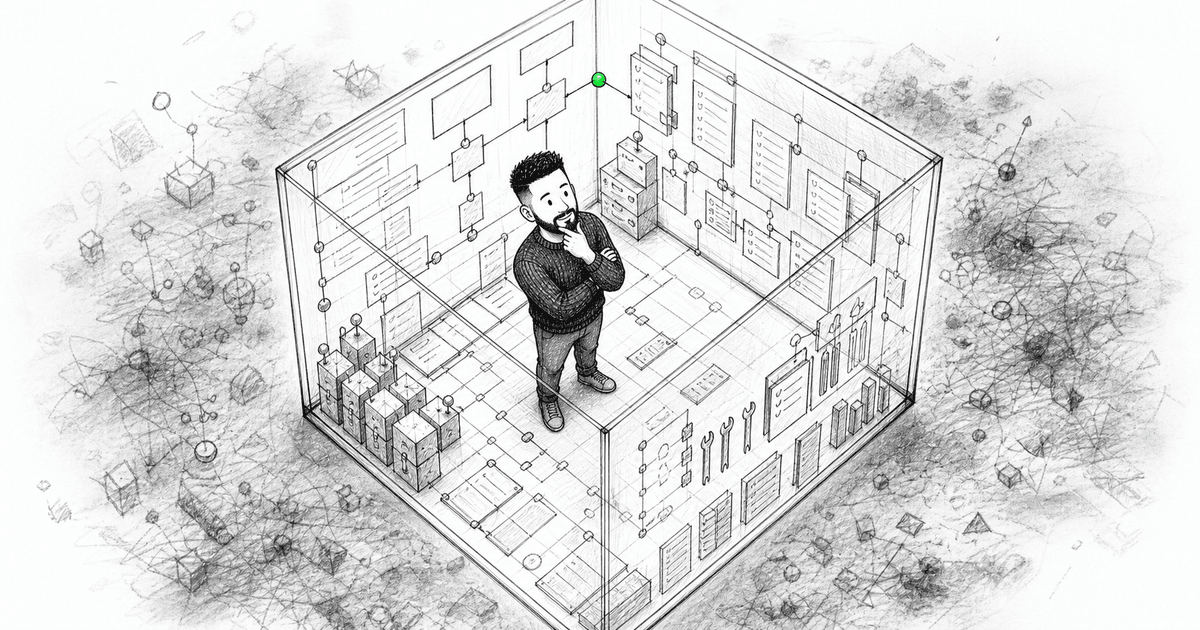
A model can be brilliant and still be useless in your project.
Give it a ticket with no surrounding context, a repository with no map, and a handful of tools with vague descriptions. It will produce something plausible. That is exactly the problem. Plausible is not the same as correct.
I used to think of context as the thing I supplied to an agent before the real work began. The prompt, the files, the issue. Now I think that is backwards. Context is not the preamble to the work. Context is the product I am building around the model.
An agent is only as good as the world it can see before it makes a decision.
The model is not the whole system
The model gets most of the attention because it is the visible intelligence. But an agent run is closer to a small operating system than a chat completion. It has a goal, a working memory, tools, permissions, project rules, and a history of decisions. Change any of those and the same model behaves differently.
That is why comparing agents by model name alone is incomplete. Two teams can use the same model and get completely different results. One gives it the repository map, the conventions, the API documentation, and a clear stop condition. The other gives it a ticket and hopes the model guesses the rest.
The second team is not using a weaker model. It is giving the model a weaker world.
Context has layers
The first layer is the task: what needs to change and why. A ticket that says "fix the payment flow" is not a task. It is a label. A useful task includes the observed behavior, the expected behavior, the boundary of the change, and the check that proves it is done.
The second layer is the project: where code lives, which package owns the behavior, how data moves, and which commands validate a change. This is the map that stops an agent from editing the first file whose name looks relevant.
The third layer is convention. Naming, branching, testing, commit messages, API boundaries, and the moments where the agent must ask instead of guessing. Conventions turn a technically possible action into an acceptable one.
The fourth layer is history. Why is this abstraction here? Which migration is still in progress? Which shortcut is deliberate? Without that history, an agent sees an odd line and helpfully removes the reason it exists.
The last layer is access. A tool is part of context because it changes what the agent can know and do. Read-only access to Jira creates one kind of workflow. The ability to update a ticket and open a pull request creates another.
More context is not always better
There is a trap here. If missing context causes mistakes, the natural reaction is to attach everything. Every document, every repository, every old discussion. That creates a larger transcript, not necessarily a clearer world.
Good context is selected context. It answers the next decision the agent has to make. A small project map is better than a directory dump. A short rule about API ownership is better than a hundred pages of loosely related documentation. A current decision record is better than three contradictory conversations.
The test is simple: can the agent tell which information is authoritative? If it cannot, more context increases the number of ways it can be confidently wrong.
Build the context deliberately
I would start with four durable pieces: a project map, a set of working rules, a decision log, and a list of available tools. Keep each one short enough to remain current. A stale instruction is worse than no instruction because it makes the wrong action look official.
Then connect the context to the workflow. When a task arrives, the agent should be able to discover the relevant feature, read the owning documentation, inspect recent decisions, make the smallest change, and run the expected check. That sequence is more valuable than a clever initial prompt.
This is also why the investment compounds. Every correction that becomes a durable rule improves the next run. Every tool that removes a guess improves the next decision. Every obsolete instruction you delete removes one false path.
The agent is not becoming magically smarter. The environment around it is becoming more legible.
The reframe
The exciting part of agents is usually the model. The durable advantage is the context architecture around it. Models will change. A clear project map, coherent rules, useful tools, and visible decisions will keep paying rent.
So when an agent keeps making the same kind of mistake, I do not begin by asking whether I need a stronger model. I ask what part of the world was invisible, ambiguous, or contradictory at the moment it decided.
That question moves the work upstream. You stop polishing prompts and start designing the environment in which decisions happen. The next question is obvious: if tools define what the agent can see and change, tool design is part of the agent's intelligence too.
Take one recurring correction from your last agent session and ask what context would have prevented it. Write that context where the next session can actually find it. That is the beginning of the product.
More than a blog post
I share frontend news and the reasoning behind it throughout the day. Pick the language that feels natural to you.