When an Agent Should Ask Instead of Acting
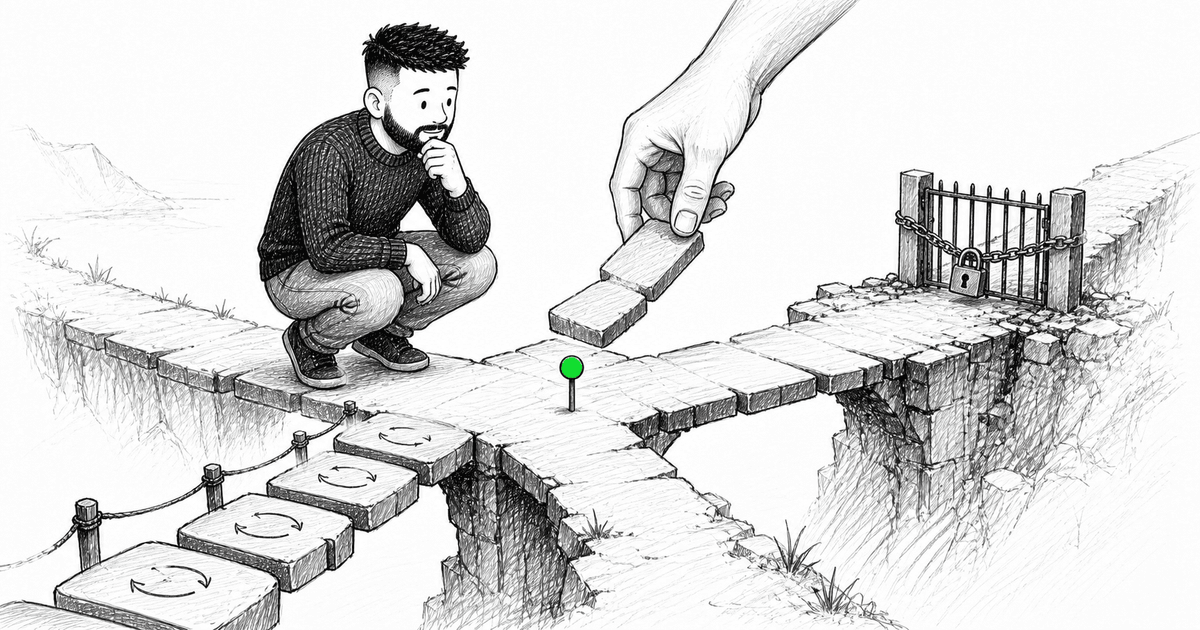
The most frustrating agent is not the one that asks too many questions. It is the one that asks about harmless details and confidently guesses at the dangerous ones.
"Which branch should I use?" after you have defined the convention is noise. "Should I push this change to production?" is exactly the question you want.
That difference is the whole design problem. An agent should not be maximally autonomous. It should be autonomous in the places where its decisions are clear, reversible, and within the rules you have agreed on.
Autonomy is not a volume knob. It is a map of decisions, boundaries, and consequences.
Not every uncertainty matters equally
An agent can be uncertain about a variable name and still make a safe choice. It should not be equally free to guess about an unknown business rule, a missing permission, or a destructive operation.
I find it useful to separate decisions into three questions:
- Is the intent clear?
- Is the action reversible?
- Is the consequence contained?
When all three answers are comfortable, the agent can act. When one is uncertain, it may need a check. When several are uncertain, it should stop and ask before touching anything important.
This gives autonomy a shape. The agent is not trusted because it sounds confident. It is trusted because the decision sits inside a boundary we understand.
Make the safe path obvious
Asking is not automatically good. An agent that responds to every small ambiguity with a question simply moves the work back to you. The goal is not to eliminate judgment. It is to reserve human judgment for the decisions where it has the highest value.
That means documenting defaults. If the branch name follows a convention, the agent should know it. If a missing estimate means "ask only when the ticket is genuinely unclear," write that down. If a draft pull request is safe but merging requires approval, make the two states distinct.
The agent should not ask because it lacks courage. It should ask because the workflow tells it this decision belongs to a person.
Use staged actions
A dangerous action becomes easier to govern when it is split into stages. Instead of one tool that changes production, expose inspection, preview, and apply as separate steps.
The agent can read the current state. It can prepare the proposed change. It can show the effect. A person can approve the final operation.
This pattern is useful far beyond deployment. A pull request can be drafted before it is merged. A database migration can be generated and checked before it runs. A bulk update can produce a count and sample before it changes records.
The agent keeps momentum through the reversible work. The human appears at the sharp edge, where a mistake becomes expensive to undo.
Ask with a decision, not a shrug
There is a big difference between "I am not sure what to do" and a useful escalation. A good question contains the context, the options, the recommendation, and the consequence of each choice.
For example: "The ticket has no story points. I estimate it as five because it touches the policy form and validation flow, but the description does not say whether the API changes too. Should I use five, or wait for clarification?"
That is not the agent giving up. It has done the investigation and isolated the unresolved decision. The human only needs to resolve the part that genuinely depends on intent.
Poor escalation pushes the whole problem back: "Please clarify the task." Good escalation makes the remaining uncertainty small.
Change the boundary when the workflow matures
The right boundary is not permanent. Early in a workflow, the agent may need approval to open a pull request. After enough successful runs, drafting the pull request can become automatic while merging remains protected.
This is how I would increase autonomy: one decision at a time, based on evidence. Do not grant a broad permission because the demo looked good. Move one reversible action across the boundary, observe the results, and keep the approval where failures would be costly.
A rule that nobody revisits becomes a superstition. A rule that is changed after evidence becomes an operating model.
The reframe
People often ask whether agents are ready to work autonomously. That question is too blunt to be useful. Ready to do what, with which permissions, under which stop conditions, and with what recovery path?
A good agent can act independently for a long stretch and still be designed around human judgment. The human does not need to approve every keystroke. The human needs to own the decisions that carry intent, irreversible consequences, or unclear authority.
Look at the last time your agent asked a question. Was it asking about the right thing? Now look at the last time it guessed. That comparison will show you where the boundary actually belongs.
Once the boundary is clear, the next challenge is continuity. An agent that learns a rule in one session but forgets it in the next is not autonomous. It is repeatedly starting over.
More than a blog post
I share frontend news and the reasoning behind it throughout the day. Pick the language that feels natural to you.